Wine Bottle Weight, Shape, Glass
and Label Design Changes Over Time
(Part 2): Chateau Mouton Rothschild
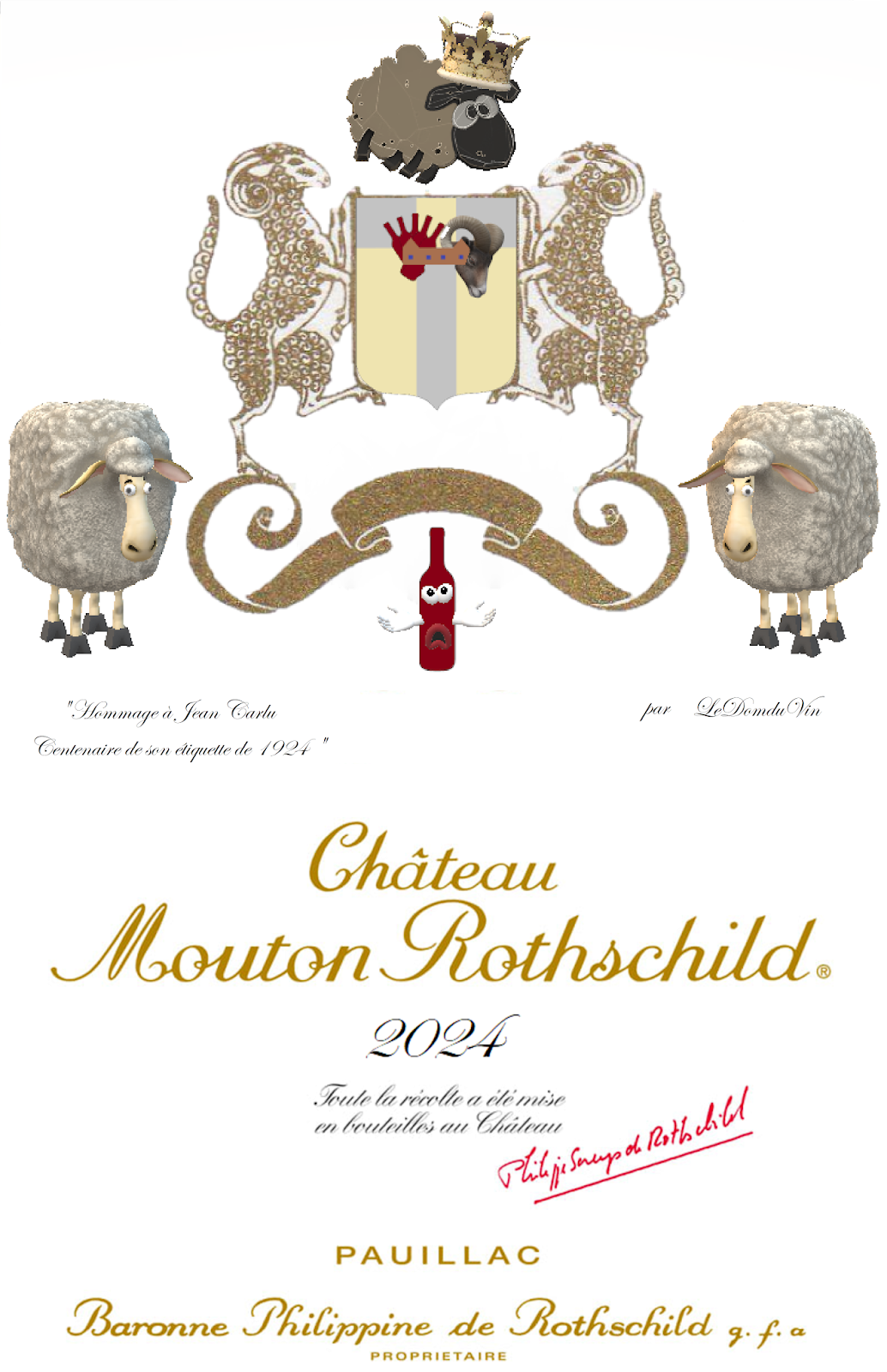 |
| Chateau Mouton Rothschild 2024 Label by © LeDomduVin 2019 Tribute to Jean Carlu |
Apology letter
To the owners of Chateau Mouton Rothschild
My deepest and most sincere apologies to the owners of Château Mouton-Rothschild, Philippe Sereys de Rothschild, Camille Sereys de Rothschild, and Julien de Beaumarchais de Rothschild, for taking such liberty and presenting my work for the label of Chateau Mouton-Rothschild 2024 vintage in such manner (😉).
I did not mean any disrespect or harm to you or your brand. In fact, I have profound respect for your family, more especially for your mother, Baroness Philippine de Rothschild, whom I had the chance and the pleasure to meet several times during my 28 years career in the wine business, and for whom I had lots of admiration, for her lively personality, her strength of character and her addictive "joie-de-vivre".
I did not mean any disrespect or harm to you or your brand. In fact, I have profound respect for your family, more especially for your mother, Baroness Philippine de Rothschild, whom I had the chance and the pleasure to meet several times during my 28 years career in the wine business, and for whom I had lots of admiration, for her lively personality, her strength of character and her addictive "joie-de-vivre".
But you have to understand that it is a tradition for me to begin my posts with an illustration of mine (usually a photo, a drawing, or a collage, etc...) specially created to introduce the subject of my blog's posts; and I thought about a (funny) tribute to Jean Carlu to celebrate the centenary of the iconic label he created back in 1924.
I personally love his 1924 vintage label (from the Art-Deco / Cubism era), which was used as the background for the coat of arms (with the rams on each side), appearing on the label of the following vintage, 1925, and has remained there ever since. There may be an unintended subliminal message in my creation... (😉)
 |
| Château Mouton Rothschild 1924 Label |
I personally love his 1924 vintage label (from the Art-Deco / Cubism era), which was used as the background for the coat of arms (with the rams on each side), appearing on the label of the following vintage, 1925, and has remained there ever since. There may be an unintended subliminal message in my creation... (😉)
As this post is mostly about Chateau Mouton-Rothschild label design changes (which have occurred over the last 120 years), I wanted to add a dash of humor by creating this "imitation" label to see if people might fall for it, looking at a potentially genuine label at first sight (you never know, some people not looking too closely at first glance might think it could be....).
I tend to think that my illustrations can be either funny or sarcastic (or even a bit "cerebral" sometimes, with "rather-french" 2nd-degree jokes and a metaphorical sense of humor... (*)). Some sort of gimmicks to amuse my readers, helping, in a "ludique" (playful) way, to digest all the contents of my posts, which are often too long, too detailed and irritably too often derivating from and, hence, losing focus on the original subject... (sorry, that's the way my mind works and that's also my writing style in both French and English....sigh...); and therefore, I could not resist the temptation to start this post on such an iconic Bordeaux wine with a label of my own creation.
I hope you will forgive me and be merciful for the liberty I took to create this label for a vintage that has yet to come without you commissioning me to do it. I'd appreciate you considering it a potential candidate label for this upcoming vintage. (No worries if you don't, but I had to ask... you never know...😉)
Thank you for your understanding.
Thank you for your understanding.
Deepest regards,
Sincerely yours,
LeDomduVin
Now that my apology is out of the way, and without further ado, let's move on to the post. Again, this is a lengthy post with interesting details, facts, and stories (as I always try to provide you with within most posts).
Prologue: While writing the first post on the same subject, I created the collage below, called "Mouton Rothschild label designs over the last 120 years" and, (as usual), started to write quite intensively about the history and design evolution of these particular labels of Chateau Mouton-Rothschild. When I realized how long the post was already (part 1), I decided to cut the part on Château Mouton-Rothschild and paste it in this brand new post (part 2), which is now a post on its own, solely dedicated to the history and design evolution of the labels of Chateau Mouton-Rothschild over the last 120 years (to which I added a few lines at the end on the bottle shape, weight and glass used for the Mouton's bottles, like I did for Chateau Latour in part 1).
Read the previous post on the same subject, "Wine Bottle Weight, Shape, Glass and Label Design Changes Over Time" (part 1) (featuring Château Latour) here
Read the previous post on the same subject, "Wine Bottle Weight, Shape, Glass and Label Design Changes Over Time" (part 1) (featuring Château Latour) here
Chateau Mouton Rothschild
Wine Bottle Weight, Shape, Glass
and Label Design Changes Over Time
Château Mouton-Rothschild is probably the best example to take when talking about bottle and, more especially, label design changes over time, as it is one of the only (if not THE only) Châteaux or wine estate in the world that has changed its label design so many times over the years, since its acquisition by Baron Nathaniel de Rothschild back in 1853.
Like all great stories, it begins with "Once upon a time,..." Baron Philippe de Rothschild (great-grandson of Baron Nathaniel) and 4th generation of the Rothschild family owning the Château, had the brilliant idea to commission artists to create artworks to embellish the label of Château Mouton Rothschild.
Between 1853 and the early 1920s, Château Mouton Rothschild's label slightly evolved but insignificantly compared to the drastic design changes that occurred subsequently.
To celebrate the first bottling at the Château ("Mise en bouteilles au Château") of the vintage 1924, bottled in 1927, Baron Philippe commissioned Jean Carlu (1900-1997), a graphic artist, famous for his poster works regarded as an expression of the dominant artistic movement at that time called the "Cubism", to create the label of the 1924 vintage. The visual impact of this particular label distinguished the 1924 vintage label as the beginning of a new era for Mouton Rothschild.
Immediately after, the label of the 1925 vintage was changed again to a rather discreet and sober visual design compared to the loud and colorful 1924 vintage label. From 1925 to 1944, the label continued evolving with the following vintages, gaining elegance, refinement, and sophistication.
Yet, it is only with the 1945 label, to commemorate the "Victory" and the end of World War II, that Baron Philippe started and established what would become a tradition with all the labels of the subsequent vintages by commissioning another contemporary artist to design the label of Mouton-Rothschild 1945 vintage (bottled in 1948). This time, he commissioned a young, unknown artist, Philippe Jullian (1921-1977), who displayed early promise as a designer and became a successful dramatist. After Jullian submitted several drafts, Baron Philippe chose the one based on the famous “V for Victory” that Churchill used throughout the war to rally the forces of freedom.
The 1945 label became a beacon, an expression of quality and taste, and a canvas for previously unreleased artworks inspired by and crafted for Château Mouton Rothschild, a genius visual marketing stunt pioneered by Baron Philippe.
Thus, the tradition of commissioning a contemporary artist to embellish and revamp the label design of Château Mouton-Rothschild for each vintage was born. The rest is history.
 |
| Chateau Mouton-Rothschild Label Designs over the last 120 years by ©LeDomduVin 2019 |
Brief history and details of the most significant design changes
for Château Mouton Rothschild labels from 1853 to 1945
(and a few more recent ones too)
- 1853 - Baron Nathaniel de Rothschild (1812-1870), of the English branch of the eponymous family, bought the Château Brane-Mouton for a sum of 1,125,000 francs (or roughly 172,000 Euros, a colossal sum at the time) and immediately renamed the Château "Mouton-Rothschild". The vineyard at this time was in bad shape as it had been no longer maintained for a few years, as the only building was an old, dilapidated farm offering no living or sleeping accommodation possibility; thus, the owners never lived on site and were just appointing someone as a manager to take care of the vineyards and the wine. Baron Nathaniel, living in Paris then, appointed Theodore Galos, a Bordeaux Negociant who owned a few vineyards, as the estate manager. Within 2-3 years, Theodore rapidly upgraded and restored the vineyard and the cellars.
 |
| Chateau Mouton Rothschild Vintage 1855 Label - ©LeDomduVin 2019 |
- 1855 - Exposition Universelle de Paris and Bordeaux Classifications - Emperor Napoleon III requested the members of the Chamber of Commerce and Industry of Bordeaux to produce a ranking of the most prestigious properties of Bordeaux to be presented at the Universal Exhibition of Paris (World Fair), which took place from May 15 to November 15 1855 on the Champs Elysees. This classification was based on the reputation, notoriety, and prices of these properties (the prices of the past ten or even fifty years, according to some sources), directly related to the quality of the wines at this time. Despite the efforts of Theodore Galos to restore the vineyards and cellars in order to increase the value of the property (which was on the rise at that time), Mouton-Rothschild was not classified as a first growth, which seems logical considering that the selection criteria was based on the property prices over fifty years, and knowing the fact that the vineyards and the farm were left unattended for years by owners not leaving on-site, thus diminishing the value of the estate. Not having a proper Chateau or mansion on site and being recently acquired by a British probably did not help either. However, Chateau Mouton-Rothschild was still classified as a 2nd Growth. From 1855 to 1888, the labels only mentioned "Mouton" (not yet "Chateau Mouton Rothschild") and bore the name of "R. Galos," named after "Roche Galos", the estate manager at that time.
NB: For those of you who might wonder (like I did), I was not able to find any info regarding the link between "Theodore Galos" and "Roche Galos", both supposedly being the estate manager of Chateau Mouton Rothschild at that period, and both appearing in many texts and references on the history of the Chateau. Are they two different persons? Or are they the same person? If anyone knows, please let me know. I will be very interested. More especially knowing that officially "Theodore Galos" was appointed by Baron Nathaniel as the estate manager and has been credited for restoring the vineyards and cellars; while "Roche Galos" is also mentioned in many texts as the estate manager and his name appears on the labels between 1855 and 1888. I read countless articles and even extracts of books on the subject, and I still could not figure it out. So, if you did, please tell me.
- 1880 - The son of Nathaniel de Rothschild, Baron James de Rothschild (1844-1881), began construction of the Chateau and named it: Petit Mouton
 |
| Chateau Mouton Rothschild 1889 Label - Photo courtesy of picclick.fr |
- 1889 - "Baron de Miollis" Label - Baron Augustin de Miollis (1864-1939) was appointed estate manager. The labels still only mentioned "Mouton" (not yet "Chateau Mouton Rothschild"), and from 1889 to 1920, bore the name of "Bon de Miollis". You can also notice the first few changes on the label:
- The name of the appointed manager changed from "R. Galos" to "Bon de Miollis", "Bon de Miollis - Gérant", which translates to "Baron de Miollis - Manager"
- The name of the owner of the Chateau changed from "Baron de Rothschild, Propriétaire" to "Hers du Bon de Rothschild Propres", which is the abbreviation of "Heritiers de Baron de Rothschild Propriétaires"
- The wines were still not bottled and labeled at the Chateau at that time, but by a 3rd party, usually a Négociant, buying the wine, then taking care of the bottling and labeling, and even the aging sometimes, or by someone appointed as the estate manager also in charge of the bottling and labeling.
 |
| Chateau Mouton Rothschild 1900 Label - Photo courtesy of picclick.fr |
- 1900 - The turn of the century, still showcasing the "Baron de Miollis" Label (1889-1920)
 |
| Chateau Mouton-Rothschild 1920 Label |
- 1920 - The label is redesigned: The Baron introduced on the label the design of the stylized Château as well as a bundle of 5 arrows, but still without preceding the name "Mouton" with the term "Château", while the Négociants (Bordeaux Wine Merchants/Traders) already used the name "Château Mouton". It is interesting to notice that the notion of provenance is now clarified with the addition of "Pauillac, Gironde" on the label (then "Pauillac, Médoc" later on) to precise the Appellation of Origin. The owner's name has also changed to "Baron Henri de Rothschild", one of the 2 sons of Nathaniel de Rothschild, who took over after the passing of his father in 1870 but let the Chateau be run by the manager in place, Baron de Miollis, and the Cellar Master Gustave Bonnefours.
- 1922 - A new era began for Chateau Mouton-Rothchild: On October 22, 1922, the grandson of Nathaniel de Rothschild and second son of Henri de Rothschild, Philippe de Rothschild (1902-1988), took the direction of the property provided that he stopped car racings. Philippe immediately came up with one of his most famous quotes, which he gave as a motto to the Chateau: "Premier ne puis, second ne daigne, Mouton suis", which translates to "First I could not, second I do not deign, Mouton I am". Under Philippe's direction, the estate took off and reached the glory it deserved.
 |
| Chateau Mouton-Rothschild 1924 Label |
- 1924 - First real label design change: In 1924, on the initiative of Baron Philippe de Rothschild, all the wines produced were, for the first time, bottled at the château (at the same time and in agreement with Château Margaux). To mark this event, the Baron commissioned Jean Carlu (1900-1997), a graphic artist famous for his poster works regarded as an expression of the dominant artistic movement at that time, called "Cubism", to create the label of the 1924 vintage. This same label has also been used for 1918, 1920, 1921, and 1926 vintage (according to a source). Some were labeled that way due to late released bottles from the Chateau for the famous wine retailer chain (caviste) "Etablissements Nicolas" (founded back in 1822).
 |
| Chateau Mouton Rothschild 1925 Label |
- 1925 - Once more, the label is redesigned and resembles what it will become later on. The lines are clean, elegant, and refined, and despite being heavily criticized at the time, this label will be used for the 1925, 1926, and 1928 vintage, along with the other label designed by Jean Carlu above, which has also been used for the 1926 vintage for example. Notice the details of the "logo", specifically created for Chateau Mouton Rothschild, representing two rams standing on an unmarked ribbon on each side of a coat of arms shield featuring the details of the 1924 vintage label created by Jean Carlu, surmounted by a crown (and what could be vines atop the crown? not sure..) and a blank ribbon underneath.
 |
| Carruades de Mouton Rothschild 1927 Label |
- 1927 - The harvest was mediocre. Therefore, Baron Philippe decided that no wine would be sold under "Château Mouton-Rothschild". Instead, the wine produced on that particular vintage was sold under "Carruades de Mouton-Rothschild". Baron Philippe commissioned Jean Carlu again to create a special label for this vintage.
 |
| "Le Second Vin" 1993 and "Le Petit Mouton" 1994 de Mouton Rothschild labels |
NB: This specific label was re-used in 1993 for the 2nd wine under the name of "Le Deuxieme Vin de Mouton Rothschild", then again in 1994 under the definitive name of "Le Petit Mouton de Mouton Rothschild", a name that has remained the same ever since.
 |
| Chateau Mouton Rothschild 1929 Label |
- 1929 - Back to a similar label to the one of the 1925 vintage, yet, with a redesigned "logo" (or "Emblème" or "Ecu" or "Blason" or "Coat of Arms", or whatever else you call it), I call it "logo", as a "Blason" or "Coat of Arms" is usually attributed to a family with royal, noble or military roots passed on generations, while the "logo" on this label was specifically created for Château Mouton Rothschild for the 1925 vintage label (see above). It was redesigned with larger, more defined details of similar figures and details already on the 1925 label. When comparing the 1925 and 1929 labels, both logos represent two rams, standing on an unmarked ribbon on each side of a coat of arms shield featuring the details of the 1924 vintage label created by Jean Carlu, surmounted by a crown. This label will be used for the 1929 to 1931 vintage. No wine was produced under Chateau Mouton Rothschild in 1930 and 1932, only under Mouton Cadet.
 |
| Château Mouton Cadet 1930 Selection Rothschild Label |
- 1930 - No wine was produced under Château Mouton Rothschild for the 1930 and 1932 vintage, as the quality of both vintages was not good enough to go into the "Grand Vin". Yet, even of lesser quality, the wines of these 2 particular vintages were still made with the same care as better vintages and, therefore, were good enough to be sold. Consequently, Baron Philippe de Rothschild decided to launch, in 1930, a new label (a 2nd label, not a 2nd wine) called "Mouton Cadet. Interesting to notice that this label of Mouton Cadet is far more complex than the current one, boasting elegant writings, with the signature of the Cellar Master, and the "logo" or "coat of arms" of both siblings: Mouton Rothschild and Mouton d'Armailhacq.
NB: Mouton-Cadet, although seemingly sold as a second wine at the time, was not a second wine but a second label, meaning that it was a wine on its own rather than being, like the second wine of the "Grand Vin" (common name for the "first wine" of the Chateaux in Bordeaux). In 2017, I wrote a post about 1st and 2nd growth, and 2nd wine and 2nd label. You can read it here (if interested).
 |
| Château Mouton Rothschild 1931 Labe Courtesy of Cellar Tracker |
- 1931 - The same label as 1925 to 1929 label. The only difference is the apparition of the writing Mouton Rothschild in the "blason" (or "coat of arms")
- 1931 - Comte Roger de Ferrand, owner of Chateau d'Armailhacq, launched the limited company "Domaine de Mouton d'Armailhacq" regrouping 3500 shares of 1000 French francs each. Baron Philippe de Rothschild became a minority shareholder.
 |
| Château Mouton Rothschild 1932 Label (courtesy of Cellar Tracker) Fake/counterfeit Label |
- 1932 - As stated above, No wine was produced under Château Mouton Rothschild for the 1930 and 1932 vintage. Therefore, imagine my surprise when I stumbled across this particular label of Chateau Mouton Rothschild 1932 online (especially on such serious wine geek websites as Cellar Tracker) while searching for the label of another vintage. I could have been fooled if I did not know better. But I realized, at first glance, that this particular label is a fake, counterfeited for whatever reason, but definitely a fake, which is very interesting (more especially for an experienced Sommelier and Wine Control Director like me, who's in charge of the wine inspection and authentication for the company I work for) as I immediately felt the need to study it and scrutinize it to note the number of mistakes made by the counterfeiter, by comparing it with the 1933 label, and more especially the 1934 label below.
- The label: No wine was produced under Château Mouton Rothschild for the 1932 vintage; therefore, this label cannot exit to start with !!!
- The vintage: The vintage states 1932, but the text underneath states harvested in 1934 and bottled in 1937 (which basically indicates that someone took the label of the 1934 vintage and changed the vintage to 1932 instead of 1934)
- The text: Comparing it with the 1934 vintage label below, it is clear that my intuition in the second point is confirmed; the text is the same as of the 1934 vintage, except the total amount of bottles produced
- The total amount of bottles produced: 134,989 bottles were produced for the 1934 vintage, not 139,074 bottles like on this fake 1932 label
- The color of the serial number: back then, the color of the serial number was black, not red. The red color came later on.
- The mention "Mis en Bouteille au Château" was not on the label until later.
- Conclusion: There is no doubt whatsoever and this is a fake/counterfeit label for all the reasons cited above. The counterfeiter made a convincing label for amateurs, but there were too many mistakes for people with a keen eye to spot anomalies at first glance due to their experience.
 |
| Château Mouton d'Armailhacq 1933 Label Courtesy of chateau-darmailhac.com |
- 1933 - The domain of Armailhacq is sold to the Baron de Rothschild, and in 1934, the Comte de Ferrand dies.
 |
| Château Mouton Rothschild 1933 Label |
- From 1933 (to 1944) appears a text mentioning the date of the bottling, as well as the number of bottles produced, in mixed quantity, including bottles, half-bottles, magnums, jéroboams, and imperials, as well as a serial number proper to each bottle and the signature of Baron Philippe.
 |
| Château Mouton Rothschild 1934 Label Courtesy of Oregon Wine History |
- 1934 - This is a genuine label of Chateau Mouton Rothschild's 1934 vintage. It is interesting to compare it with the fake 1932 vintage label above if you haven't done it yet... Interesting to notice also the disappearance of the "s" at the end of "bouteille" in the mention "Mis en Bouteille au Château", which was written "Mis en bouteilles au Château" (so, with an "s") since 1924.
 |
| Château Mouton Rothschild 1936 Label Picture courtesy of Christies.com |
- 1936 - The mention "Mis en Bouteille au Château" is moved from the bottom of the label to the top of the label, curved around the "blason" ("coat of arms") (it might have been done for the 1935 vintage too)
 |
| Château Mouton Rothschild 1937 Label Courtesy of Cellar Tacker |
- 1937 - "Château Mouton Rothschild" is moved above the vintage and the main text. The mention of "Appellation Pauillac-Médoc Controlée" is moved at the beginning of the text, and the names "Pauillac" and "Médoc" disappear from the bottom of the label
 |
| Château Mouton Rothschild 1939 Label |
- 1938 - 1941 - Baron Philippe de Rothschild is imprisoned at the prison of Vichy; therefore, Baron Philippe de Rothschild's signature does not appear on the labels of Château Mouton-Rothschild during that period. The labels of 1938, 1939, 1940, and 1941 vintages all resemble those of 1939 above.
 |
| Château Mouton Rothschild 1942 Label |
- 1942 - Baron Philippe de Rothschild escaped the Vichy prison and fled to London. The vintage 1942 was bottled in 1945 at the end of the war. The Château, which had been occupied by the Germans during the war and managed by Heinz Bömers (1893-1978), named as the weinführer of Bordeaux by Hermann Göring (1893-1946), is restituted to the Rothschild Family. Baron Philippe is back, and the label is restored to what it used to look like for the 1936 vintage, including the Baron's signature and with "Château Mouton Rothschild" at the bottom of the label (below the vintage and the text).
 |
| Chateau Mouton Rothschild 1942 Label Courtesy of Philippe Margot "Galerie d'art sur Bouteilles I - Les étiquettes de Château Mouton Rothschild" |
- 1942 - Looking for a label of the 1942 vintage, I stumbled across this particular label, which, as per Philippe Margot, in his book "Galerie d'art sur Bouteilles I - Les étiquettes de Château Mouton Rothschild" (that you can read here - it is in French), is also an official label of the 1942 vintage, which has been recognized by the Château Mouton Rothschild as being genuine without giving more explanation on the reason why 2 labels were created for this specific vintage.
That weird choice of Latin words..... Even the Latin word "HIC EST BONUM MOUTON" could appear as a joke as the literal translation means "THIS IS GOOD MOUTON"
As the Château will not release more info on this specifically weird-looking label of Mouton Rothschild 1942 vintage, it will remain a mystery... or an unsuccessful label design stunt/attempt 😊
 |
| Château Mouton Rothschild Verticale 1940 -1945 Picture posted by and courtesy of Patrick Lubarski on LinkedIn in 2017 |
- 1943 - It is interesting to notice that on the picture above, courtesy of Patrick Lubarski (owner of SAS Vin 24) posted on his LinkedIn account about 2 years ago, the label of Château Mouton Rothschild's 1943 vintage is smaller than 1942 and 1944. I searched for a while online to see if I could find any clues of the reason why, but I couldn't find any (after all, it is my role as Wine Quality Control director to understand and know this kind of thing, and it is good for me to have this kind of records when doing wine inspections). In fact, studying the position of the label of the 1943 vintage on various pictures of bottles of that particular vintage, it seems that the format of the 1943 label is, in fact, smaller than the previous and following vintage, but I believe that I saw some regular formats too. So: Are both formats available (the regular and the smaller size)? I do not want to jump to conclusions as I do not have the facts or know the answer to this question. However, you have to admit that it is quite strange to see both formats (unless the smaller size is the original label and the regular size might correspond to a later release; or, unless the availability of the paper for the label runs out due to the war and only small labels could be printed at the time... not sure). In fact, we can say that the 1943 label is the same size as the bottom label of the 1945 to 1949 vintage.
NB: in reference to the original subject of this post which also includes the changes in the "glass of the bottles", it is important to notice the color and thickness of the glass in the picture above. As stated many times in various previous posts (read it here, for example), you have to remember that historically, during WWII, glass used to produce wine bottles was less available, as well as sulfur used to produce darker more amber glass, and consequently bottles ended up being lighter in weight (less thick) and lighter in color too (being clearer, tending on nearly transparent and light blue to light green, as you can see on the picture above). Note that the color and heaviness of the glass used gradually returned to thicker darker green glass by 1948 when the 1945 vintage was bottled.
 |
| Château Mouton Rothschild 1945 Label - LeDomduVin |
- 1945 - Although Baron Philippe's initial idea of commissioning artists to embellish the label of Château Mouton Rothschild appeared first with the 1924 vintage and was further developed within the few subsequent vintage's label changes, it was not until the 1945 vintage that the tradition of incorporating an artist's work atop the main label really started. "In 1945, to commemorate the Allied victory, Baron Philippe de Rothschild had the idea of embellishing the Mouton Rothschild label with artwork: in this instance, a symbolic design intended to celebrate the return of peace. He commissioned this from an unknown young artist, Philippe Jullian (1921-1977). Having displayed early promise as a designer, he was to become a successful dramatist. He submitted several drafts for the label: this one is based on the famous “V for Victory” that Churchill used throughout the war to rally the forces of freedom." courtesy of www.chateau-mouton-rothschild.com
NB: As stated in my previous posts on Mouton Rothschild 1945 (read it here), the label of Château Mouton Rothschild 1945 is divided into 2 distinctively different labels that are slightly different. The upper one, on which the "V" represents "Victory" ("Victoire" in French), to commemorate the ending of World War II, is smaller in height but more particularly smaller in width by a few millimeters on both sides (as you can see on the picture above). The lower or main label is detached from the upper one and slightly wider in width. If you encounter a bottle of Mouton 1945 with the 2 labels attached and/or even detached but with the same width, then it is surely a fake bottle, a counterfeit that you should immediately report to the Château, which will investigate. Funny enough, when looking at labels of Château Mouton Rothschild 1945 online, most of them have both upper and lower labels attached together and with the same width, which makes me believe that these are probably fakes (unless certified released from the Château; ask to see certification if that is the case).
FYI: It is said that 20-25% of the top 50 most expensive and top wines of the world on the market (more especially the tiers French wines from Bordeaux and Burgundy) are actually fakes, extraordinary well-crafted counterfeits that usually challenge even the eyes of the best experts on the market. It is also said that more of these fake bottles of top-tier wines are in circulation worldwide than the total amount ever produced at the winery back then. This, in my opinion, is not surprising, knowing how difficult it was to access these old and rare vintages (especially any vintages prior to the 50s) already back in the mid-1990s (there were barely any available at the time, as most of them had been either consumed or for the last few remaining ones kept as part of inaccessible collections) compared to nowadays where they seem to be available pretty much everywhere.... go figure... Rudy Kurniawan may have been caught and imprisoned for 10 years back in 2012, but his legacy has definitely been survived by his fellow peers and others who came to be inspired by his works.
 |
| Château Mouton Rothschild 1945 to 1949 Label Picture courtesy of World Wine Consultant SA |
As you can see in this "verticale" of Château Mouton Rothschild 1945 to 1949 vintage (in the picture above, courtesy of World Wine Consultant SA), the labels (upper and lower) are detached and slightly different in width for the 1945 and 1946 vintages only.
Starting with the 1947 vintage, the "Jean Cocteau" label, both upper and lower, was attached together, forming only one label (separated by a black line) and had the same width. The black line separating the artwork (upper label) from the rest of the label (lower label) last appeared on the 1962 label, after which the bottom of the artwork solely defined where the upper label finishes and where the lower label begins.
Voilà! This was my brief history and details of the most significant design changes for Château Mouton Rothschild's label from 1853 to 1945. Hope you liked it as much as I did searching for all these details and writing about them.
Now, I will not do all the labels since 1945. I will just point out the few most significant label design changes that occurred from 1945 to present
Brief history and details of the most significant design changes for Château Mouton Rothschild labels from 1945 to present
Strangely enough, the next most significant changes in Château Mouton Rothschild label design, from 1945 to present, came with the vintages 1953, 1973, 1993, and 2003 (not counting the 2000 vintage, as the whole bottle was engraved and thus, technically, there is no label...)
 |
| Château Mouton Rothschild 1953 Label |
- 1953 - The label for this particular vintage was designed to commemorate the acquisition of the Château Mouton Rothschild on May 11th, 1853, by Baron Nathaniel de Rothschild. This label, and thus the vintage, is dedicated to Baron Philippe's great-grandfather Baron Nathaniel, grandfather James, and father Henri de Rothschild, the 3 generations who ran the estate prior to Baron Philippe took over on October 22nd, 1922.
 |
| Château Mouton Rothschild 1973 Label Courtesy of Château Mouton Rothschild |
- 1973 - Although 1973 was a very bad vintage in Bordeaux, it is my birth year, and that's is the main reason I wanted to add it to this post; but also because the artwork is from Pablo Picasso, whom I love both as an artist and as a man for the type of life he had, and thirdly because, compared to all the previous and subsequent labels, it is one of the biggest artworks featured on a Château Mouton Rothschild label (see the whole collection of labels in the picture below to see what I mean), which makes it quite relevant and important, and visually appealing (in my opinion).
 |
| Château Mouton Rothschild 1993 Labels Collage by ©LeDomduVin 2019 |
- 1993 - A list of Château Mouton Rothschild label design changes will not be complete without the controversial label of the 1993 vintage. Created by "Balthus", the pseudonym of Count Balthazar Klossowski de Rola (1908-2001), and perfectly accepted as is (back then) in France and in Europe in general, the drawing he made for the Mouton Rothschild 1993 vintage, featuring a dreamy, naked adolescent girl in a reclining position, sparked outraged reactions across the Atlantic. The TTB (the Alcohol and Tobacco Tax and Trade Bureau), in charge of judging what is acceptable or not on a label, and thus giving the approval of the labels for wines produced in or imported into the US, disapproved the reclining nude, finding the drawing of a naked girl on a label completely inappropriate and violating the sensibilities of US citizens (puritanism oblige). Baroness Philippine de Rothschild, the owner of Château Mouton Rothschild, took over the 3 Chateaux she inherited when her father, Baron Philippe de Rothschild, passed away in 1988 (Mouton as well as Château d'Armailhac and Château Clerc Milon), decided not to fight the US bureaucracy and instead just removed the drawing from the label for the US market only.
PS: the blank label above is "for example only" and may not reflect the true blank label, which is the same as the one with the drawing, but without the drawing... (obviously...)
 |
| Château Mouton Rothschild 2003 Label |
- 2003 - This particular label was designed to commemorate and mark the 150th anniversary of the acquisition of Château Mouton Rothschild in 1853 by Baron Nathaniel de Rothschild, hence his portrait as the main feature of the label.
And last but not least.....
 |
| Château Mouton Rothschild 2000 Bottle |
- 2000 - Mouton Rothschild celebrated both the New Century and New Millenium by engraving the bottle of this particular vintage with a very finely chiseled and detailed replica of "The Augsburg Ram" in 24-carat Gold. The "Augsburg Ram" is a "chased silver-gilt drinking vessel created around 1590 by Jakob Schenauer, a German master goldsmith". (*)
Et Voilà! This concludes my brief history and details of the most significant design changes for Château Mouton Rothschild labels from 1945 to present.
Here is the collection of Mouton-Rothschild labels from 1945 to 2013 (photo courtesy of www.theartistlabels.com) for you to have a better view of the label design changes over the last 70 years.
 |
| Chateau Mouton Rothschild Labels from 1945 to 2013 - photo courtesy of www.theartistlabels.com |
Like I did for Château Latour in my previous post on the same subject (post 1 - read it here), here are a few examples of bottle weight and glass thickness and heaviness changes over time for Mouton Rothschild.
Wine Bottle Weight, Shape and
Glass Thickness and heaviness change over time
 |
| Chateau Mouton Rothschild Full and Empty bottles 1947, 1949, 1970, 1982, 1990 and 1995 - photo ©LeDomduVin 2019 |
Looking at this picture, I took in our cellar (above) of various vintages of Château Mouton Rothschild, you can easily notice the changes and evolution of the bottle and label shape and size, as well as the differences in the thickness and heaviness of the glass used. You can also notice the differences and evolution of the capsules.
- Château Mouton Rothschild 1947 and 1949 - the bottle is tall, with broad shoulders and heavy, thick, dark color glass; the front label(s) is small (smaller than later versions)
- Château Mouton Rothschild 1970 and 1982 - the bottle is slightly smaller, leaner, lighter in weight, and lighter in color too, and was made with less heavy and less thick glass than 1947 and 1949
- Château Mouton Rothschild 1990 and 1995 - the bottle is about the same height as 1970/1982, with slightly higher and broader shoulders and slightly darker and thicker, heavier glass, too. Still not as tall, broad, thick, heavy, and dark as in 1947/1949
In terms of weight, I took the following picture to check the weight variations of empty bottles to verify the thickness and heaviness of the glass.
 |
| Château Mouton Rothschild 1970, 1982 and 1990 empty bottle weights by ©LeDomduVin 2019 |
- 564g (grams) for Château Mouton Rothschild 1970
- 567g for Château Mouton Rothschild 1982 (in fact, it is probably 564, too, due to the few grams added by the cork)
- 545g for Château Mouton Rothschild 1990; although the glass looks darker and may appear thicker, the empty bottle of 1990 is about 22g lighter than 1970
For this particular exercise, I also weighed empty bottles of Haut Brion, Lafite Rothschild, and Cos d'Estournel, but I realize that this post is quite long (once again), so to conclude it, I will just put these last 3 pictures.
 |
| Château Haut-Brion 1966, 1982, 1989, and 1990 empty bottles by ©LeDomduVin 2019 |
 |
| Château Cos d'Estournel 1961, 1986 and 1990 empty bottles by ©LeDomduVin 2019 |
 |
| Château Lafite Rothschild 1959 and 1961 empty bottles by ©LeDomduVin 2019 |
I will end this post here (parts 1 and 2), as I could continue writing on this fascinating subject forever, but you might get bored with me too. So, let's finish on a high note with this picture of Château Lafite Rothschild's 1959 and 1961 empty bottles. I hope you liked learning about all these details as much as I researched and wrote about them.
That's all, folks!
Santé! Cheers! And stay tuned for more posts like this one (factual and educational) coming soon.
Dom (aka LeDomduVin aka Dominique Noël)
PS: you can read the part one of this post here
(*) I see some of you scratching your heads sometimes when looking at my illustrations, prior to getting the joke only after a few seconds of consideration... 😉
(*) Info about Chateau Mouton-Rothschild was taken or partly taken from the Château website at https://www.chateau-mouton-rothschild.com/, but also from a very interesting and useful online book (in French) by Philippe Margot, titled "L'intégral des étiquettes de Château Mouton-Rothschild de 1855 à aujourd'hui" that you can read here
#bordeaux, #ledomduvin, @ledomduvin, #wine, #wineeducation, #wineknowledge, #bottlesizes, #bottleweight, #labels, #history, #bottleshapes, #pauillac, #moutonrothschild, #vin, #vino, #wein, #labeldesign, #lesphotosadom , #dominiquenoel
Unless stated otherwise, all rights reserved ©LeDomduVin 2019, on all the contents above including, but not limited to, photos, pictures, drawings, illustrations, collages, visuals, maps, memes, posts, texts, writings, quotes, notes, tasting notes, descriptions, wine descriptions, definitions, recipes, graphs, tables, and even music and video (when and where applicable).


