Thursday, August 15, 2024

LeDomduVin: Bubbly foam pattern (froth) on top of the wine in the glass after using Coravin


Bubbly foam pattern (froth) on top of the wine

 in the glass after using Coravin


Have you ever experienced a bubbly foam pattern (froth) on top of the wine in the glass after using Coravin?

If not, know that it may happen; even if your glass is spotlessly clean, it has nothing to do with the wine, and this is usually the reason why.

It is usually due to a slight excess of gas released into the glass before or after pouring the wine. If the wine is frothy at first (like in the picture), you might press the Coravin button too hard or too many times.

You're supposed to tap the button, wait for the wine to stop pouring, tap again, and so on until you've poured your desired amount.

This method is a bit slow, but you're not supposed to hold the button down or quickly press it multiple times while pouring the wine. Otherwise, you will release this excess of gas.

To prevent foam, press the button once before pouring the wine to release the excess gas in the air rather than in the glass; then, you can pour the wine into the glass. It might take some practice before you get used to it and become a pro at using Coravin.

If you always get the frothy pattern, do not panic. The argon gas used in Coravin is inert, colorless, odorless, and nonreactive, so it has no adverse effects on the wine.


And for those who are not familiar with Argon, here are a few facts:

Argon is added to wine to displace air. Because it is denser than air, it settles above the liquid, protecting the wine from souring and oxidation.

This method often preserves open wine and liquid bottles in bars, restaurants, and even barrels in wineries.

Argon does not dissolve in wine and, therefore, provides a long-term blanket of protection for the wine.

As for the time of preservation, Coravin claims to "preserve wine for months", yet from personal experience, it is more likely to be a few weeks, depending on the amount of wine remaining in the bottle, of course (the more wine in the bottle the longer).

Hope you've found this post helpful.

Cheers! Santé!

Dom

@ledomduvin #ledomduvin @coravin #coravin #wine #frothywine #froth #domainehumbert #burgundy #wineservice #wineeducation #sommelier #sommelierlife #sommlife #ilovemyjob #wineyearly


Unless stated otherwise, all rights reserved ©LeDomduVin 2024, on all the contents above including, but not limited to, photos, pictures, drawings, illustrations, collages, visuals, maps, memes, posts, texts, writings, quotes, notes, tasting notes, descriptions, wine descriptions, definitions, recipes, graphs, tables, and even music and video (when and where applicable).

LeDomduVin: Champagne Henriot, William Fevre Chablis and Chateau Brane-Cantenac


Champagne Henriot, William Fevre Chablis and Chateau Brane-Cantenac 


Sometimes, I do serve affordable wines! 😉😄👍🥂🍷


Champagne Henriot Millesime 2008


Established in 1808, Champagne Henriot is one of the rare independent Champagne houses that has remained in the same family throughout its history. The 2008 vintage celebrates its 200th anniversary. 

A blend of 50% Chardonnay and 50% Pinot Noir, Henriot 2008 is a delightful champagne. It is fresh, crisp, rich, dense, and "gourmand." It has lovely stone fruits, white flowers, mineral aromas, great acidity, structure, texture, and a long lingering finish. It is really enjoyable and a steal at that price! 


William Fevre Chablis Grand Cru Bougros 2016


Light yellow color with green nuances. Fresh, clean nose, mineral, white and yellow stone fruits, lemony aromas, with light buttery notes. Fresh, clean, and zesty on the palate, focus and steely with razor-sharp acidity, balanced, light and limpid, cleansing. Loved it. 


Chateau Brane-Cantenac Margaux 2001


I found the 2001 vintage somewhat thin and austere but still quite enjoyable. The wine presented secondary and tertiary aromas with red cherry, raspberry, black currant, liquorice, earth, minerals, and some oaky and vegetal notes. The palate has good acidity and moderate tannins, yet it was light and lacked complexity and texture. The finish was shorter than I would have liked. Although lacking in substance and depth, the wine tasted fresh and juicy, with slightly unripe red fruit tones and vegetal notes that needed some time to mellow with aeration. I carefully decanted the wine to allow it to breathe and to prevent any sediments in the decanter. It was ok, but not my favorite vintage from this Chateau. 

Cheers! Santé!

Dom

@ledomduvin #ledomduvin @champagnehenriot #champagnehenriot #champagne @williamfevre_chablis #williamfevre #chablis #burgundy @chateau_branecantenac #branecantenac #chateaubranecantenac #margaux #bordeaux #sommelier #sommelierlife #sommlife #ilovemyjob #wineyearly #tastingnotes 


Unless stated otherwise, all rights reserved ©LeDomduVin 2024, on all the contents above including, but not limited to, photos, pictures, drawings, illustrations, collages, visuals, maps, memes, posts, texts, writings, quotes, notes, tasting notes, descriptions, wine descriptions, definitions, recipes, graphs, tables, and even music and video (when and where applicable).

Wednesday, August 14, 2024

LeDomduVin: Mise en place!


Mise en place!


When you're a Sommelier, having some classics from Bordeaux and Burgundy on hand in the cellar is essential. 😊👍🍷 

Cheers! Santé!

Dom

@ledomduvin #ledomduvin #chateaulatour #latourpauillac #latour @domainemongeard #mongeardmugneret @chateaumargaux #chateaumargaux #classics #miseenplace #sommelier #sommelierlife #sommlife #ilovemyjob #wineyearly


Unless stated otherwise, all rights reserved ©LeDomduVin 2024, on all the contents above including, but not limited to, photos, pictures, drawings, illustrations, collages, visuals, maps, memes, posts, texts, writings, quotes, notes, tasting notes, descriptions, wine descriptions, definitions, recipes, graphs, tables, and even music and video (when and where applicable).

LeDomduVin: Dom Perignon Vintage 2013


DOM PERIGNON 2013


You’ve got to love Dom Perignon!

I opened these bottles the other day, which inspired me to write an article about the evolution of Dom Perignon over the last 40 years. 

Work in progress. Check my blog in September for the article. 


Dom Perignon Vintage 2013 


Fresh, crisp, elegant, and racy, it is lighter, less rich, and less textured than the 2012 (IMO), yet it has lovely density and structure with refreshing acidity. It boasts floral and mineral aromas and flavors with yellow fruits and yeasty nuances. Perfect as an aperitif and with light appetizers. 

Cheers! Santé!

Dom

@ledomduvin #ledomduvin @domperignonofficial #domperignon #champagne #sparkling #france #sommelier #sommelierlife #sommlife #tastingnotes #ilovemyjob #ilovechampagne


Unless stated otherwise, all rights reserved ©LeDomduVin 2024, on all the contents above including, but not limited to, photos, pictures, drawings, illustrations, collages, visuals, maps, memes, posts, texts, writings, quotes, notes, tasting notes, descriptions, wine descriptions, definitions, recipes, graphs, tables, and even music and video (when and where applicable).

Thursday, July 11, 2024

LeDomduVin: Chateau Montrose Saint-Estephe 2009


Chateau Montrose Saint Estephe 2009


It was cigar night again on the yacht (not mine; I just work there😅), and I needed to open something that would pair well with it. I usually like to open rich and bold Bordeaux wines with Cigars.

A Pauillac is always a good match, yet I wanted to open something different. I had this bottle of Montrose 2009 in the cellar, and I knew it would not disappoint.

Bordeaux 2009 is a solar vintage offering plenty of ripeness, richness, and boldness that can easily support and enhance the cigar's complexity.

That bottle of Montrose 2009 demonstrated that it could do just that and so much more.


Chateau Montrose Saint Estephe 2009


In the glass, it boasts an intense ruby-red, opaque color. The nose is dark, ripe, warm, captivating, and inviting, offering lots of dark fruits and berries mingling with earthy, smoky notes of coffee, leather, graphite, pencil shave, and toasted oak. The palate is rich, opulent, thick, bold, and beautifully textured. Its structure is balanced between the fruit ripeness, just enough acidity to keep it fresh and juicy, and plenty of earthy tannins (slightly austere, as always, a common trait of Saint-Estephe wines) that will ease with time. The potent and complex mid-palate ends on a long, earthy finish. 

This warm, dense, powerful, charming wine offers excellent aging potential. It is one of the most complex and full-bodied Montrose I have tasted. It is definitely too young if you ask me, but still, I loved it. 

Decanting about one hour and a half before serving is recommended. 

In the absence of a good cigar, have it with food! 😉

This is the epitome of great wine. 

Cheers! Santé! 

Dom

@ledomduvin #ledomduvin @chateau_montrose #chateaumontrose #montrose #saintestephe #bordeaux #wine #vin #vino #wein #tastingnotes #sommelier #sommelierlife #sommlife #ilovemyjob #wineyearly


Unless stated otherwise, all rights reserved ©LeDomduVin 2024, on all the contents above including, but not limited to, photos, pictures, drawings, illustrations, collages, visuals, maps, memes, posts, texts, writings, quotes, notes, tasting notes, descriptions, wine descriptions, definitions, recipes, graphs, tables, and even music and video (when and where applicable).

LeDomduVin: Some exceptional wines! Krug, Marc Colin and Mongeard-Mugneret


Some exceptional wines! 

Krug, Marc Colin and Mongeard-Mugneret


I opened these bottles for a private dinner in a private club. I was excited as I hadn’t tried these bottles for a while.  It is not every day that I open bottles at more than 10K HKD (more than 1200 Euros) per bottle (at least for 2 of them). It would be a Sommelier's dream if I could.  Yet, I’m lucky enough to be able to do it occasionally.


Krug Clos du Mesnil Blanc de Blancs 2006


Right after popping the cork, fresh, delicate aromas of apple, pear, and stone fruits mingling with lightly toasted brioche, mineral, and floral notes emanated from the bottle. The palate was rich, ample, generous, and layered, yet silky and sophisticated, with barely perceptible refined bubbles. It had a gorgeous “vinous” quality (as we say in French), resembling more of a wine than a Champagne. Balanced and focused, it expanded bountifully from the attack to the aristocratic lengthy finish. Although beautiful on its own, I recommend having it with rich and creamy dishes. What a magnificent, debonaire, and noble champagne!


Marc Colin Batard Montrachet Grand Cru 2018


Beyond its pale golden color, it offered powerful aromas of yellow and stone fruits, combined with floral, mineral, toasted, buttery notes and herbal hints I could not describe (like Tea, maybe?). This Batard Montrachet was rich, ample, generous, and layered like the champagne above, yet it was more concentrated and potent. Fortunately, it has enough acidity to keep it fresh and balanced. I loved its structure and texture, enhanced with that glycerine sensation that coats the palate. Lots of minerality and butteriness with a hint of green tea in the lingering finish. It could benefit from a few more years in the cellar. One of the best Batard Montrachet I have had in a while!


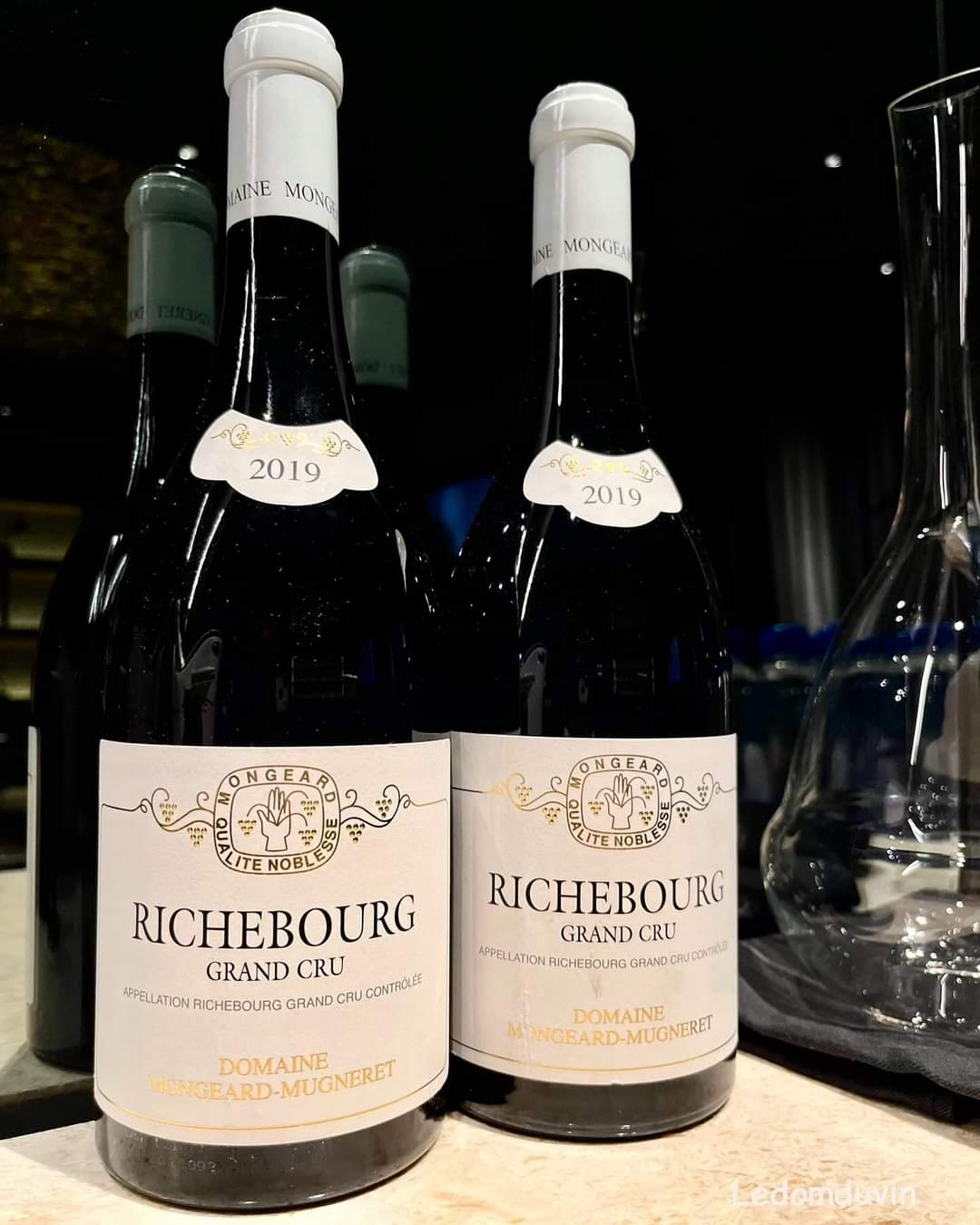
Mongeard-Mugneret Richebourg Grand Cru 2019


Beautiful, fresh, attractive nose. The first aroma that came to my mind was “griottes” (a French word for “wild cherries”), then red and dark berries, combined with earthy, herbal, and mineral notes and peppery, spicy hints. The palate is juicy and tangy, offering plenty of freshly squeezed grapes and zesty acidity, with earthy notes mingling with present yet integrated tannins that will mellow with time. Gently concentrated and textured elegantly and refreshingly, it displays a sophisticated structure gaining complexity from the juicy attack and the expanding palate to the smooth, seamless finish. Opening such a young wine with so much potential was a sacrilege. Yet, what a memorable experience!

Cheers! Santé!

Dom

@ledomduvin #ledomduvin @krugchampagne #krug #champagne @domainemarccolin #marccolin #batardmontrachet @domainemongeard #mongeardmugneret #richebourg #grandcru #burgundy #wine #tastingnotes #vin #vino #wein #sommelier #sommelierlife #sommlife #ilovemyjob #wineyearly


Unless stated otherwise, all rights reserved ©LeDomduVin 2024, on all the contents above including, but not limited to, photos, pictures, drawings, illustrations, collages, visuals, maps, memes, posts, texts, writings, quotes, notes, tasting notes, descriptions, wine descriptions, definitions, recipes, graphs, tables, and even music and video (when and where applicable).

Saturday, July 6, 2024

LeDomduVin: Blind tasting of Chateau Latour 1995 - A beautiful surprise!


Blind tasting of Château Latour 1995 

A beautiful surprise! 


Last night, I was challenged to do a blind tasting to find this wine. 

While I was taking care of a private dinner in one of the Salons of the company's Private club, my colleague Sommelier, Leo, brought me a glass of wine from the party he was taking care of. 

He said: "You have to guess what it is."

I have always loved blind-tasting, as it challenges your senses, taste buds, brain, memory, skills, knowledge, ego, and reputation.

A good Sommelier always proceeds by elimination, making educated guesses based on his/her knowledge, experience, and skills to define the region, the grape variety(ies), the vintage, the appellation, and, if really good, even the name of the Cru, the name of the Chateau/Domaine/Estate, and/or the owner or winemaker's name. 

So, I took the glass and proceeded to a thorough examination. 

1. Aspect/Color: I always look at the aspect and color first to define the age. Medium garnet color with orange brick reflects on the rime and many sediments. It was too advanced to be in the 2000s, yet it was not old enough to be in the 80s.

It had to be in the 90s.

2. Nose/aromas: Beautiful yet subtle and delicate nose, with aromas of dark berries, cassis, licorice, sandalwood, with marked earthy notes of forest floor and light truffle, some discreet floral hints.

Bordeaux immediately came to mind. It was pretty obvious on the nose already. A good vintage for sure: not 90, maybe 95, 96, or 98.

3. Taste: I was startled by how good this wine was. Sophisticated, layered, complex, and generous yet in a very refined, subtle, elegant, and classy style. Very focused and perfectly integrated with no roughness, excellent balance, seamless finish, and refreshing acidity. This wine was not about weight like some of these super-extracted powerhouses. It was all about elegance, sophistication, and subtlety.

Such a well-crafted wine could only be one of the Top Bordeaux. Due to its refreshing acidity, I was thinking about 96.

Leo was looking at me with eyes showing he was kind of impressed I immediately guessed it was in the 1990s. While he didn't agree or disagree, I knew I was right. My guts and experiences rarely failed me. 

4. Region/Appellation: Left bank or right bank? That is the question.

Left Bank: Haut-Medoc, for sure. One of the Top appellations, but which one? The wine was not dry and austere enough to be a Saint-Estephe. Too serious and aristocratic to be a Saint-Julien. Too rich and complex to be a Margaux. In fact, the nose and palate resembled more of a Pauillac. Could it be? Definitely possible...

And yet, the earthiness and slight hint of truffle reminded me somewhat of something between a Saint-Emilion and a Pomerol. A "Saint-Pomerol," joked Leo. I like this amusing analogy. 😁👍🍷

Right Bank: Why not? Maybe? Due to the wine's quality and characteristics, it could be a Saint-Emilion or a light Pomerol. 

5. The grape(s): The wine was quite round, soft, and integrated, so it felt more like a Merlot-based wine than a Cabernet-based wine. Its silky texture reminded me of some wines from Cheval-Blanc, but without the tannins of the Cabernet Franc. 

Due to its earthiness and complexity, I opted for Pomerol. If correct, it had to be one of the Top: Petrus, Le Pin, Lafleur, Vieux Chateau Certan, La Conseillante, Trotanoy, L'Evangile, La Fleur-Petrus ... etc... 

Yet, if it was based on Cabernet Sauvignon, then it could only be one of the first growths. 

Difficult to tell. My mind was thinking Pomerol, but my taste buds were telling me to stick with the Left Bank, a Saint-Julien maybe, but more probably a Pauillac due to its complexity, layered structure, and sophisticated overall texture and mouthfeel. A high pedigree, no doubt. 

This blind tasting was harder than I thought it would be. And yet, I was happy as my senses, taste buds, knowledge, and skills were not so rusty after all. It was an exciting challenge. 

More especially, Leo was trying to lead me down the wrong path while I reflected and thought aloud. 

Seeing that I may have reached a conclusion,  Leo finally said: "So, what do you think?"

I answered: "Definitely a Bordeaux. Vintage... I will say 1996 due to its freshness and juiciness and because it does not show any of the ripe or even jammy characteristics of a hot or solar vintage. Probably Merlot-based due to its softness and medium color. Maybe a Pomerol due to its earthiness and a slight hint of truffle, reminding me of a Vieux Château Certan I tried (I am a huge fan of VCC). I will say Petrus or Vieux Chateau Certan 1996."

Yet, that said, my taste buds and my heart continued to tell me that I should have stuck with my first choice of the Left bank. 

He replied: "Very interesting, but it is a Pauillac and a 1995 vintage. In terms of the quality, you are correct, it is a Top Wine, it is one of the first growths." 

(Dang! I knew I should have stuck to my first impression... )

My mind was racing: "It is too polished and silky to be Lafite Rothschild. Too consistent and focused to be Mouton-Rothschild. Too rich and complex to be Margaux. Not characteristics enough to be Haut-Brion. And yet, normally, Latour is a much heavier and stronger wine. More especially in a hot/solar vintage like 1995. How could it be?" 

I was puzzled and startled at the same time... 

Leo disappeared and came back with the empty bottle and another glass containing a small amount of it so that I could enjoy it again. I was ecstatic. 


What an incredible wine and such a beautiful surprise! 

It was a real challenge for me as the wine presented characteristics that, in my opinion, resembled more of 1996 than 1995. Also, the angularities usually found in Cabernet Sauvignon-based wines (e.g., heavy structure and texture, solid tannins, and even astringency, etc...) had all disappeared and integrated over time. The wine has such a medium color, a light structure, and a silky, gentle, elegant texture, and it was so fresh and juicy, so youthful, too; I thought it was from a cooler vintage, with higher acidity and less concentration. Yet, I was wrong. 

Not completely wrong as I guessed the region and decade, but still wrong, as I could not have guessed the appellation of Pauillac, even if my guts and taste buds told me that it could be it in the first place.

Lesson learned: one should always trust his/her first impression and gut feeling.  

Moreover, I couldn't even have guessed the Chateau, as I would have never imagined that Chateau Latour, which is usually such a strong, rich, opulent, complex, and generous wine, could become such a refined, elegant, racy, and subtle wine, overtime, 29 years later. 

However, this bottle of Chateau Latour 1995 was absolutely stunning and a great example of the striking wine quality only this Chateau is capable of in Pauillac. 

I recommend you to try it if you have the opportunity one day. 

Once again, it proved that blind tasting is hard and that even the best of us can have a tough time guessing when we are tricked and steered wrongly by some preconceived ideas and past experiences. 

This blind-tasting exercise was humbling, as even a knowledgeable, experienced, and skilled Sommelier and Wine Buyer like me, with a 33-year career in the wine industry and a highly trained palate, opening and tasting top-tier Bordeaux and Burgundy wines regularly can have a hard time guessing. 

Thank you, and kudos to Frédéric Engerer and his team at Château Latour. This is a magnificent wine! 

Cheers! Santé!

Dom

@ledomduvin #ledomduvin @_chateaulatour #chateaulatour #pauillac #bordeaux #blindtasting #tasting #tastingnotes #wine #vin #vino #wein #sommelier #sommelierlife #sommlife #ilovemyjob #wineyearly 


Unless stated otherwise, all rights reserved ©LeDomduVin 2024, on all the contents above including, but not limited to, photos, pictures, drawings, illustrations, collages, visuals, maps, memes, posts, texts, writings, quotes, notes, tasting notes, descriptions, wine descriptions, definitions, recipes, graphs, tables, and even music and video (when and where applicable).

Thursday, July 4, 2024

LeDomduVin: Chateau Haut-Brion Pessac-Léognan 2016 (again)


Chateau Haut-Brion Grand Cru Pessac-Leognan 2016


It is sentimental between Chateau Haut-Brion and me.

I first tasted Haut-Brion in 1994. It was a 1986 vintage, and I fell in love that day.

I was lucky to work in a “Relais et Chateaux” located in Talence, bordering Pessac. Most of the wines on the list were from the appellations “Graves” and “Pessac-Leognan.” We also had a few vintages of Haut-Brion.

Then, one day, a customer brought a magnum of Haut-Brion 1959. The wine was magnificent. It was an epiphany. I was 21 years old and had never tasted such an incredible wine.

Later, in September 1996, my Sommelier Promotion was invited to spend a week at the Chateau to participate in the harvest. It was an incredible memory!

We were even given a bottle of Haut-Brion 1993 (or was it 1994? My memory is failing me) as a present for our contribution from Mr Jean-Bernard Delmas. And I can proudly say that I have harvested some of the 1996 vintage.

Since then, my love for Haut-Brion has never ceased to grow. I visited the Chateau many times in the early to mid-2000s. In my 33-year career as a Sommelier/wine Buyer, I have always had Haut-Brion on all my wine lists (and shelves when I worked in retail).

I have been lucky enough to open countless amounts of this wine over the years, from the 1945 vintage to 2018 for the most recent vintage, and pretty much everything in between.


I have repeatedly said that Chateau Haut-Brion is my favorite Bordeaux wine, and this 2016 vintage confirms it again!

The last time I tried the 2016 vintage was in October last year, and it was beautiful! And 10 months later, it is still a masterpiece.

Haut-Brion 2016 offers plenty of gorgeous red and black berry and fruit aromas, refreshing acidity, outstanding balance, excellent structure, a long finish, and a good grip of integrated tannins that will mellow down with time. Its freshness and richness enhance its soft and silky texture. It is sophisticated, focused, elegant, and racy. What a wine!

Cheers! Sante!

Dom


@ledomduvin #ledomduvin #wine #vin #vino #wein @chateauhautbrion_ #hautbrion #pessacleognan #grandcru #graves #bordeaux #tastingnotes #sommelier #sommelierlife #sommlife


Unless stated otherwise, all rights reserved ©LeDomduVin 2024, on all the contents above including, but not limited to, photos, pictures, drawings, illustrations, collages, visuals, maps, memes, posts, texts, writings, quotes, notes, tasting notes, descriptions, wine descriptions, definitions, recipes, graphs, tables, and even music and video (when and where applicable).

Friday, June 21, 2024

LeDomduVin: Domaine Hubert Lignier Clos de la Roche Grand Cru 2016


Domaine Hubert Lignier Clos de la Roche Grand Cru 2016


Along with Champagne Salon 2007 and Fontaine-Gagnard Batard-Montrachet 2020 (see previous posts), I also served Hubert Lignier Clos de la Roche Grand Cru 2016.

Domaine Hubert Lignier needs no introduction. It is one of the unavoidable classic producers of Morey-Saint-Denis, one of the appellation's staples and one of Burgundy's most renowned and sought-after producers.

They produce wines from the Côte de Nuits (Clos de la Roche, Morey-St-Denis, Gevrey-Chambertin, Chambolle-Musigny, Nuits-St-Georges) and some in Côte de Beaune (Pommard, Monthelie, Volnay).

"Their wines are authentic and sensual, expressing their own terroir," as Laurent Lignier (the son of Hubert), who now runs the Domaine, likes to say humbly.

The estate has followed organic practices since 2006 and was certified "Agriculture Biologique" (AB) in 2019.

Wine quality is directly linked to their vineyard, mainly consisting of old vines planted through massale selections. The oldest vines were planted in 1936. Since the 1990s, they have implemented soil cultivation practices such as plowing and hoeing, completely avoiding herbicides and insecticides.

The estate focuses on caring for the vines and preserving biodiversity in the face of climate change's impact on the vineyard and surrounding environment.

In the cellar, minimal intervention maintains the fruit's quality, balance, and complexity. Grapes are hand-harvested, sorted, fermented in tanks, and aged for almost two years in oak barrels with 20 to 30% new oak.

The wines are then racked and bottled by gravity without filtration or clarification. This results in balanced and refined wines with significant aging potential while remaining relatively approachable at a young age.

Their Clos de la Roche 2016 embodies the classic Burgundian style. It is attractive, light, ruby, and medium-bodied. It combines great fruit and terroir expression with elegance, complexity, precision, depth, freshness, structure, texture, and balance while maintaining a distinctive natural and ethereal quality. I loved it.

Cheers! Santé!

Dom

@ledomduvin #ledomduvin @domainehubertlignier #hubertlignier #wine #vin #burgundy #closdelaroche #grandcru #tasting #tastingnotes #sommelier #sommelierlife #sommlife #ilovemyjob


Unless stated otherwise, all rights reserved ©LeDomduVin 2024, on all the contents above including, but not limited to, photos, pictures, drawings, illustrations, collages, visuals, maps, memes, posts, texts, writings, quotes, notes, tasting notes, descriptions, wine descriptions, definitions, recipes, graphs, tables, and even music and video (when and where applicable).

Thursday, June 20, 2024

LeDomduVin: Domaine Fontaine-Gagnard Batard-Montrachet Grand Cru 2020


Domaine Fontaine-Gagnard 

Batard-Montrachet Grand Cru 2020


Domaine Fontaine-Gagnard is in the village of Chassagne-Montrachet. It was established in 1985 by Laurence Gagnard and her husband, Richard Fontaine, following Laurence's inheritance of a portion of Domaine Gagnard-Delagrange.

Céline Fontaine (Laurence and Richard's daughter) joined her family estate in 2007 and now runs the Domaine, which encompasses 12 hectares of vineyards, mainly in Chassagne-Montrachet, across several Premiers Crus and a few plots in Volnay and Pommard.

They also hold holdings in the prestigious Grands Crus vineyards of Le Montrachet, Bâtard-Montrachet, and Criots-Batard-Montrachet and a few plots classified as Bourgogne rouge and Bourgogne blanc.

Their wine range covers 22 different appellations. Roughly two-thirds of production is devoted to white wine (around Chassagne-Montrachet) and one-third to red (Volnay and Pommard).

In the vineyard, they use sustainable agriculture methods to respect and be as close as possible to nature. They have adopted a less interventionist approach in the cellar, allowing the wines to reach their full potential and reveal each terroir's best expressions and characteristics.

They use natural indigenous yeasts. Aging takes place in oak barrels. The percentage of new oak varies from 15-20% for the Village appellations and 30-40% for the Premiers Crus and Grands Crus. The wines usually spend 12 months in oak for the whites and up to 18 months for the reds. Light fining and filtration before bottling.

Domaine Fontaine-Gagnard is still "under the radar" and thus produces delicate yet complex and refined, classic-style Burgundian wines at very reasonable prices while only making a tiny amount. For example, this Batard-Montrachet hailed from only 0.3 hectares of vines out of the 11.24 hectares of this Grand Cru vineyard's surface.


Fontaine-Gagnard Batard-Montrachet 2020


Beyond its pale yellow color, the nose was light, fresh, elegant, mineral, zesty, and citrusy. At first, slightly restrained, the palate slowly opened, revealing a fresh, dry, mineral texture, good density, lots of lemony flavors, sharp acidity, and lightly toasted, oaky nuances. Nice, even if a bit light to my palate for a Batard-Montrachet. I would have loved to see a bit more substance and depth. Yet, it might benefit from a few more years in the cellar. 

Cheers! Santé! 

Dom

@ledomduvin #ledomduvin #fontainegagnard #batardmontrachet #grandcru #burgundy #wine #vin #vino #wein #sommelier #sommelierlife #sommlife #ilovemyjob


Unless stated otherwise, all rights reserved ©LeDomduVin 2024, on all the contents above including, but not limited to, photos, pictures, drawings, illustrations, collages, visuals, maps, memes, posts, texts, writings, quotes, notes, tasting notes, descriptions, wine descriptions, definitions, recipes, graphs, tables, and even music and video (when and where applicable).